Small Print: The Garnishes Doing All the Talking in Britain's Bars Right Now
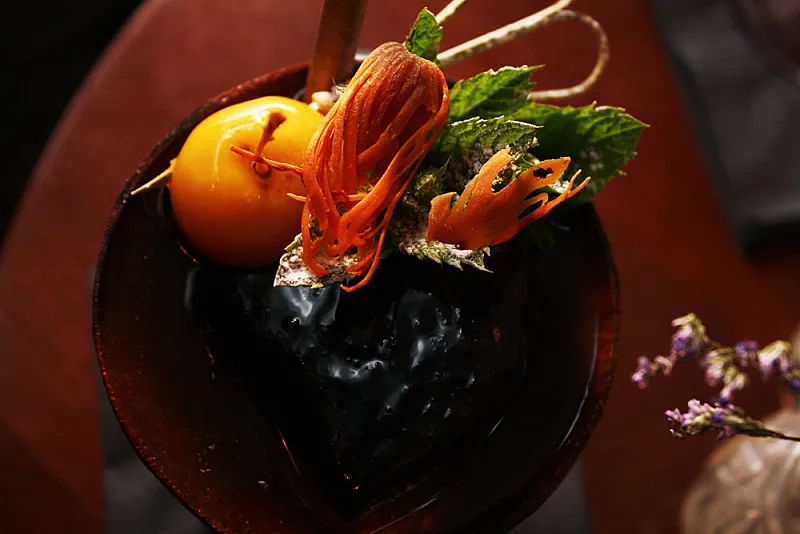
Photo: Delaina Haslam, CC BY 2.0, via Wikimedia Commons
Garnishes used to be punctuation. A slice, a twist, a maraschino cherry that had been in the fridge since the year dot. Now they arrive on a small plate, or clipped to the rim with surgical precision, or standing upright in a nest of crushed ice like something that expects to be photographed.
That isn't vanity. Over the last two years, the garnish has become the fastest way for a British bar to tell you what kind of place it is — faster than the drinks list, faster than the playlist, faster than the font on the door. Here's what we're seeing in 2026.
1. The Dehydrated Citrus Wheel Has Peaked
Let's be clear: it's not gone, and it's not bad. A dehydrated orange wheel does a job — it lasts, it looks clean, it doesn't leave a sad wet slice in the drink. But the wheel has become furniture. Every bar with a cocktail list over twelve drinks has one, and it has stopped being a signal of anything.
The barring trend worth noting is that the better venues are moving to fresh peel again. Expressed, twisted, and dropped in — using citrus for aroma rather than furniture. It's more labour, it dies in minutes, and it smells like an actual orange. That's the point.
2. House Pickles Are the Real Signature
If a bar is making its own pickles, it's a bar that plans ahead. There is no shortcut to this — you are talking about vinegar, sugar, jars, a fridge labelled in biro and about ten days of patience.
What we're seeing across the country: pickled shallots with a Gibson, pickled rhubarb in a gin number, cucumber that's been salted and vinegar-dressed an hour before service. It's the savoury answer to the cocktail cherry, and it does something a wheel of anything cannot — it makes you want a second drink.
Worth watching: bars pairing the pickle directly to the drink's origin story. A pickled walnut in a drink built around a nutty vermouth is a full sentence about intent.
3. Salt and Brine Are Doing the Heavy Lifting
The corner of the menu that's growing fastest is the savoury corner. Olives are back, and not as an afterthought — the good ones, castelvetrano or similar, properly drained and oil-drizzled. Anchovy-stuffed variants. A brine rinse on the glass for a martini that tastes like the sea rather than the bar.
This is a trend with a very British logic to it: drinkers who love salt-and-vinegar crisps have found a drink that agrees with them. The bar that leaves a small dish of the brine alongside an oyster-adjacent cocktail is telling you it has thought about the whole mouthful, not just the sip.
4. The One-Ingredient Flex
There's a school of garnishing now that treats the whole thing as a showroom for a single supplier. The very good bars are naming their source. A specific citrus, a specific orchard's honey, a specific herb grower with an allotment and a small business.
Done well, this is the most interesting thing happening in British drinks right now — because it's about provenance, which is where all drinking culture has drifted over the last decade. Done badly, it's a laminated card in a menu and a garnish that tastes exactly like a supermarket one.
5. What's Quietly Over
The edible foam. It had a good run from around 2010 to 2016 and has been haunting the odd hotel bar ever since. A foam is an answer to a question nobody asked.
Half a kiwi on the rim. Still turning up in a few places that think tropical means 1987.
The mini umbrella. Sincerely charming in a tiki bar and nowhere else.
Anything on fire that isn't a twist being flamed. Fire on a bar top is a health and safety conversation, not a flavour.
A garnish larger than the drink it sits in. Including — and we are serious — the bones of whatever animal is in the cocktail. Novelty has a ceiling.
6. The One-Ingredient Test
Here's the question worth asking next time a drink lands in front of you. Does the garnish change the drink, or just decorate it?
A twist over a martini changes the first thing you taste. A dehydrated wheel does not. A pinch of salt in a margarita's face is a deliberate act; a desiccated lime wedge on the rim is an apology. A sprig of rosemary smacked between palms and rested near the glass is doing mere suggestion, which is sometimes exactly right.
The bars worth trusting this winter are the ones where the garnish is a decision, not a decoration. If you can eat it, even better. If it makes you order a snack, best of all.