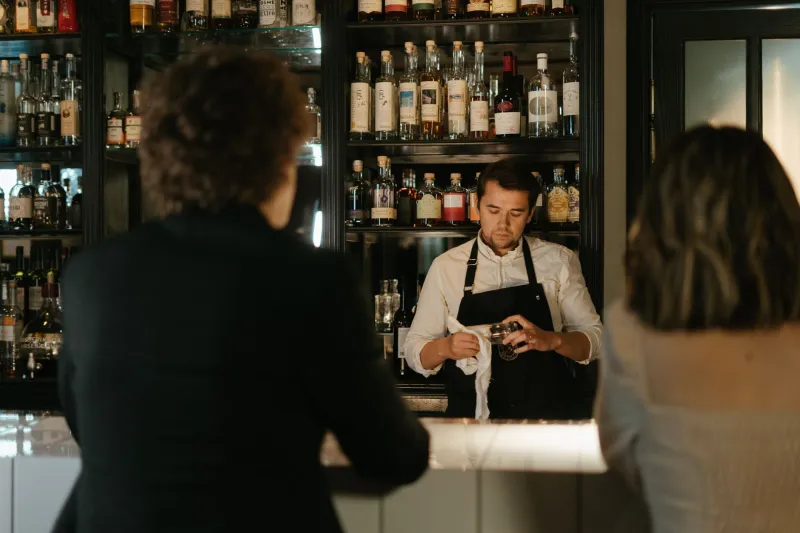
The Closing Shift: Why Britain's Best Bars Treat Last Orders Like a Curtain Call

There's a sound that ends a British night out, and it isn't the last chord of whatever was playing. It's the bell. Or the announcement. Or, in the more politely run rooms, a member of staff materialising at your elbow with the quiet news that the till is about to have its final count. Whatever form it takes, it lands the same way: a small jolt, a glance at the phone, a rapid recalculation of how much of the conversation is still worth finishing.
We've spent the past few weeks doing something faintly odd — going out with a notebook and staying until the end on purpose. Basement cocktail rooms off Old Street, a back-street pub in Leeds, a wine bar in Bristol with eleven stools and one toilet, a late licence spot in Glasgow's Merchant City that doesn't really get going until eleven. Different cities, different price points, same question: what actually happens in the last twenty minutes, and why do those twenty minutes stick in the memory far longer than the three hours before them?
The bell is a bit of theatre, and the good bars know it
The old "Time, gentlemen, please" is largely a heritage act now. Most venues have softened it — a bell rung with a grin, a hand-written card propped against the coffee machine, a floor manager doing the rounds with the warmth of someone who genuinely wouldn't mind if you stayed. But the ritual hasn't disappeared. It's just been restyled.
What separates a good ending from a bad one is whether the announcement arrives as information or as a warning. In the best rooms, it's delivered early and generously: a note that the kitchen closes at ten, that last orders are at half eleven, that there's a final call in fifteen. You get to make a decision rather than have one made for you. In the worst, it's a light going up and a shrug.
One bar manager in Manchester told us she trains staff to give the first signal at forty minutes rather than twenty, purely because it changes the mood of the room. "If you tell people at quarter to, they order, they settle, they finish properly," she said. "If you tell them at five to, they panic. Panicked people drink badly and leave badly."
The dimmer switch is a personality test
Nothing gives a bar away faster than the light cue. Somewhere between the second announcement and the clearing of glasses, the lighting does something, and what it does tells you exactly how the venue sees you.
There's the slow lean — the lighting drifting warmer and lower, glasses collected in twos rather than swept en masse, music easing down a notch so that conversations have to close themselves. It feels less like being asked to leave and more like a host starting to stack plates. Then there's the curtain-drop: everything up to full service brightness at once, as though the room has remembered it has a licence and a cleaner.
We saw both, sometimes in the same evening. The difference in customer behaviour was startling. Under a slow fade, people finished, paid, found their coats and left with something close to cheerfulness. Under the floodlight treatment, tables went silent, phones came out, and the exodus had the atmosphere of a fire drill.
Playlists do the emotional labour
Ask anyone who runs a bar late and they'll tell you the music in the last half hour is a separate job from the music in the first four hours. It's not just about volume — though yes, the volume does come down, because it has to. It's about what the song is saying.
There's a well-worn school of thought that the closing track should be something rousing, a singalong to send everyone out on a high. And there's a counter-school, more common in cocktail rooms than pubs, that argues you should never play a song people know the words to after midnight, because the whole point is to loosen the room's grip, not tighten it.
Both work, if the intent is honest. What doesn't work is the frantic last-minute shuffle — the DJ or the phone-on-shuffle suddenly realising the clock and switching to a playlist called 'empty out'. You can hear the calculation, and it does the opposite of what's intended. A pub in Sheffield we visited has a rule: the final three songs are chosen at the start of the shift, not the end, so nobody panics.
The bit nobody writes about: the door
The doorman is the last person you speak to, and quite often the only member of staff you've spoken to twice. In a venue with a proper door policy, that final exchange is a craft in itself.
A good one is short. It's a nod, a "night then", maybe a hand out for a taxi if it's raining. The theatre is in what isn't said — no comment on how much you've had, no instruction to get home safe delivered like a caution. Bad farewells, on the other hand, are the ones people remember for the wrong reasons, and they have a habit of curdling an otherwise excellent night.
One Glasgow bar has a policy of stationing its most senior member of staff on the door for the last twenty minutes, on the reasoning that the goodbye should be delivered by someone who can answer for the whole night. It's a small thing. It also explains why that particular room has regulars who can't quite put their finger on why they like it so much.
What this means if you're the one going out
You don't have to run a bar to read the room. The final twenty minutes of any night out are legible if you know what to look for, and knowing what to look for makes you a better guest.
- Watch for the forty-minute signal. If a bar tells you early, it's a bar that respects you. Order then, not at the bell.
- Take the slow fade as a compliment. When the lights come down rather than up, the venue is trying to end well.
- Don't fight the coat. The moment staff start returning jackets, the evening has a script. Follow it and the last five minutes are pleasant instead of awkward.
- Leave a proper goodbye. The bar has been your host for hours. The door staff have been standing in the cold. A nod costs nothing.
None of this is sentimentality for its own sake. A night out is a piece of theatre with a beginning, a middle and an end, and Britain's better bars have quietly worked out that the ending carries disproportionate weight. You'll forget the second round. You'll forget what the playlist was doing at nine. But you'll remember, with surprising clarity, whether the last twenty minutes felt like a curtain call or an eviction — and that's what you'll tell people about on Monday.