Light Reading: How Britain’s Glowing Bar Fronts Set the Night’s Tone
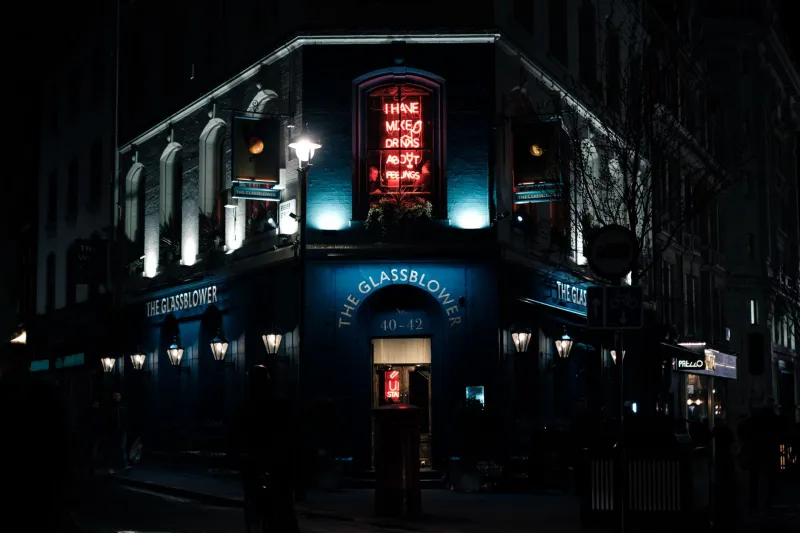
There’s a moment, usually just after the pubs have hit their first proper hum, when a bar sign stops being signage and starts being a promise. A pink neon curl above a doorway says something different from a brushed-steel plaque lit by a single spotlight. One says come in, we’re fun; the other says you’ll need a reservation and a decent jacket. Neither is wrong. But in 2026, with so many UK bars competing for the same Friday-night attention, the front of the building has become part of the menu.
The front is the first course
We talk a lot about lighting inside bars — the dimmers, the candles, the flattering pools of amber — but the exterior does the opening act. It’s the thing you spot from the end of the street, the thing that makes you cross the road, the thing that tells you whether to expect a sticky-floored singalong or a stiff martini and a whispered conversation.
A good illuminated front works like a landmark. It gives a night a shape. You meet under it, you photograph it, you use it to explain to a taxi driver where you are. And on a dark November evening, when the pavements are slick and the pubs are glowing like aquariums, a well-lit bar front is basically a public service.
Old-school glow: Soho, Haggerston and the neon holdouts
London still does classic neon better than most. Bar Italia on Frith Street is the obvious starting point — a Soho institution whose sign has been part of the streetscape since the 1950s. It’s not subtle, and it doesn’t need to be. The glow spills onto the pavement, promising late coffee, loud conversation and the kind of night that starts with an espresso and ends with a taxi you don’t remember ordering.
A few streets over, The Toucan leans on painted Guinness signage and a proper old-school pub front — less neon, more lamp-lit theatre. Then head east to The Glory in Haggerston, where the front is proudly, unapologetically queer and theatrical. The sign is a beacon for a certain kind of night: cabaret, cheap drinks, and the sense that the best part of the evening will happen after 11pm.
Up in Edinburgh, The Voodoo Rooms has a lit facade that feels like a curtain-raiser — ornate, slightly mysterious, and just bright enough to make you check your reflection before you go in. In Belfast, The Merchant Hotel does the grand illuminated entrance properly: you don’t so much walk in as arrive. And in Manchester, The Alchemist has turned glowing gold lettering into a city-centre landmark — a front that says cocktails, but make them a spectacle.
New-school glow: the quiet flex of LED lettering
Not every great bar front shouts. Some of the most distinctive signs in the UK right now are minimalist LED letters, thin-stroke neon scripts and backlit panels that look almost architectural. They’re less Vegas and more design studio with a licence to serve negronis.
You’ll find this style in Bristol at The Milk Thistle, where the sign is understated enough to make the building feel like a secret you’ve been let in on. Cardiff’s Lab 22 uses a pared-back glow that suits its experimental cocktail reputation. Leeds has a similar mood around The Domino Club — a front that doesn’t give too much away, which is exactly the point.
This is the 2026 version of a bar sign: less “look at me”, more “look closer”. It works because it makes the pavement feel like the beginning of the experience rather than just the bit before it.
A sign-spotting crawl for 2026
You don’t need a formal route. A sign-spotting night works best when it’s loose: pick an area, start at dusk, and let the lights pull you along. Here’s how to do it without turning the evening into a photoshoot that never ends.
Start early. The best sign-spotting window is that half-hour after sunset when the sky is still blue and the neon is just starting to win. In November, that’s earlier than you think. Check sunset times, wrap up warm, and plan your first stop for around 4:30pm if you want the full glow.
Pick a cluster, not a city. Soho alone can fill an evening: Bar Italia, The Toucan, and a wander towards the smaller side-street bars. Haggerston and Bethnal Green work as an east London pair. In Scotland, Edinburgh’s New Town gives you ornate fronts and lit closes within walking distance. Manchester’s Northern Quarter rewards a slow loop. Don’t try to “do” the whole city.
Book the middle stop. Sign-spotting is better when you have one proper sit-down. Book a table at the bar you’re most curious about, then build the crawl around it. That way you’re not relying on walk-ins at 8pm on a Saturday.
Photograph responsibly. A quick snap of a glowing front is part of the fun. Blocking a pavement, setting up a tripod, or shooting flash into a busy bar is not. Keep it moving, keep it kind, and don’t make the sign the main character if there are people trying to get past.
Use public transport. Obvious, but worth saying: a crawl that hops between neighbourhoods is much easier on the bus or Tube than in a car. It also means you can have a proper drink at each stop without drawing lots for the designated driver.
The etiquette of a glow crawl
A bar front is a public face, but it’s also someone’s workplace and, in some cases, someone’s home above the shop. Treat the glow with a bit of respect. Don’t lean on window ledges, don’t crowd doorways, and don’t assume a photogenic front means the bar wants a queue of people treating it like a film set.
The best sign-spotting nights are the ones where the signs are a starting point, not the whole story. You spot the glow, you go in, you order something, you talk to someone. The sign did its job. The night does the rest.
Last light
Britain’s best bar fronts are a mixed bag in the best way: old-school neon, pub lamps, LED scripts, grand hotel entrances and quiet little plaques that barely announce themselves. What they share is a sense of arrival. They tell you that the night has started before you’ve even touched the door handle.
So next time you’re planning a night out, give yourself ten minutes to look up. The sign might be the best thing you see all evening — or at least the thing that gets you through the right door.